
Updated August 3, 2026
If you received a letter from the New York City Department of Finance stating that your property “may be subject to” the new pied-à-terre tax, your first step should be to consult a qualified tax attorney or tax professional.
The rules are new, and the correct response may depend on how the property is used, valued and owned. Our team can provide recommendations and introductions to experienced professionals if you need guidance.
The good news is that the City has extended the exemption application deadline to September 18, 2026, giving property owners additional time to review their circumstances and gather the necessary documentation.
What Is the NYC Pied-à-Terre Tax?
Officially called the Non-Primary Residence Property Surcharge, the pied-à-terre tax is a new annual surcharge on certain high-value New York City homes that are not used as a primary residence.
The surcharge took effect on July 1, 2026, and may apply to qualifying one-, two- and three-family homes, condominium units and cooperative apartments.
For the first two property-tax years, the City will consider two primary questions:
Does the property meet the applicable Department of Finance value threshold?
Was the property being used as a qualifying primary residence?
If the property meets the value threshold and does –not qualify as a primary residence, it may be subject to the annual surcharge. For the 2026 surcharge, primary-residence status is generally evaluated as of January 5, 2026.
How Much Is the Pied-à-Terre Tax?
The percentage is based on the property’s Department of Finance market value, not necessarily its purchase price, listing price or estimated resale value.
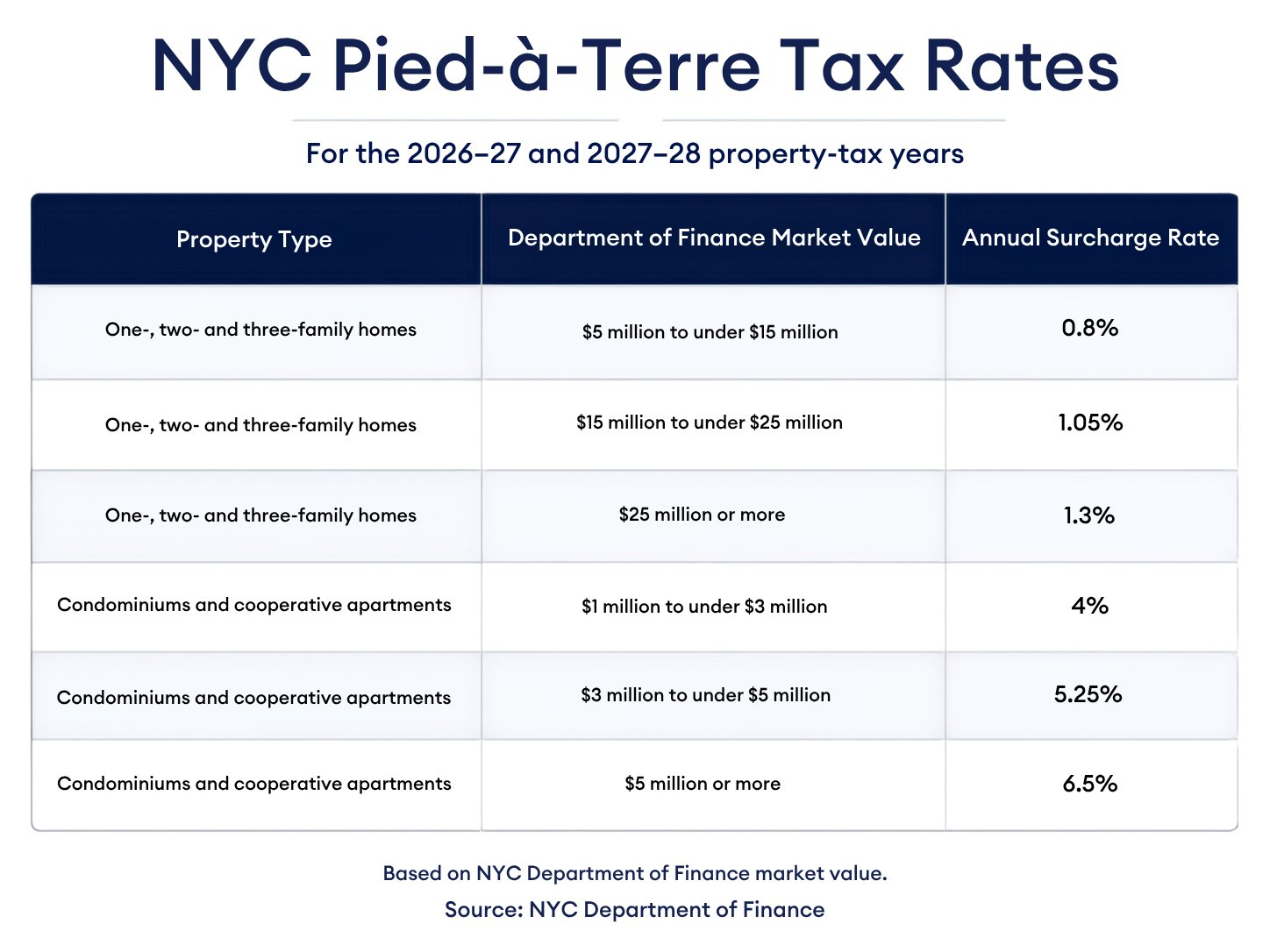
The lower starting threshold and higher rates for many co-ops and condos reflect New York City’s current valuation system. During the first phase, larger condominiums and cooperative apartments are generally valued using comparisons to rental buildings, which often produces a substantially lower value than a comparable-sales approach.
What Does the City’s Letter Mean?
Receiving a “You may be subject to…” notice does not automatically mean that you owe the tax.
The Department of Finance may have sent the letter because its records did not contain enough information to confirm that the property was being used as a primary residence. Owners who believe their property is exempt must respond and provide supporting information by the September 18 deadline.
The deadline extension applies to owners of houses, condominiums and cooperative apartments who received the notice.
Who May Qualify for an Exemption?
A property generally will not be subject to the surcharge when it is used as the primary residence of:
The property owner
A tenant or subtenant
An immediate family member of the owner
One or more individuals who collectively hold a majority interest in the LLC, corporation or partnership that owns the property
A qualifying beneficiary or beneficiaries of a trust
Immediate family includes a spouse, child, sibling, parent, grandparent or grandchild. A tenant must generally occupy the property as a primary residence under a bona fide, arm’s-length lease or sublease with a term of at least one year.
Photo courtesy of National Geographic

What Documentation May Be Required?
The Department of Finance generally asks for the occupant’s most recently filed federal or state tax return showing the property as a primary residence.
When a tax return is unavailable, the applicant may be able to submit two other forms of evidence, such as:
A driver’s license or other DMV-issued identification
A voter identification card
Other acceptable proof of primary residence
Additional documents may be required for tenants, family members, trusts, LLCs, corporations or partnerships. These may include leases, proof of rent payments, utility bills, marriage or birth certificates, trust agreements, operating agreements and ownership affidavits.
What Should You Do Before September 18?
1. Consult a tax attorney or qualified tax professional
This should be your first step, particularly if the property is owned through a trust, LLC, corporation or partnership, is occupied by a family member or tenant, or has a complicated residency history.
Our team can provide recommendations and introductions if you need help finding an experienced professional.
2. Review the notice carefully
Confirm the property address, ownership information, Department of Finance market value and filing instructions.
3. Identify the potential exemption
Determine whether the property qualifies based on its use by the owner, a family member, a tenant, a trust beneficiary or the majority owners of an entity.
4. Gather supporting documents
Make sure addresses and ownership information are accurate and consistent across tax returns, identification, leases and entity or trust documents.
5. Contact your managing agent if you own a co-op
The surcharge is assessed against the cooperative corporation. The co-op may initially pay the charge and then seek reimbursement from the shareholder whose apartment caused it to be imposed. Early coordination with the board or managing agent is therefore particularly important.
6. File by September 18, 2026
Do not wait until the final days to apply. Filing early provides more time to address missing documents, inconsistencies or technical issues.
Special Considerations for Trusts and LLCs
McDermott notes that properties owned through trusts and business entities can present some of the most complicated questions under the new rules.
A property held through an entity may qualify when individuals holding a collective majority interest use it as their primary residence. However, the Department of Finance has indicated that primary-residence status may not be established through certain multi-tiered ownership structures.
Trust-owned properties may also require closer review, particularly when a trust has multiple beneficiaries but only one beneficiary uses the residence as a primary home.
Photo courtesy of Allard Schager

The Bottom Line
A pied-à-terre tax letter is not necessarily a tax bill, but it should not be ignored.
Even owners who use their property as a full-time residence may need to submit an application proving that an exemption applies. Owners of second homes, tenant-occupied properties, co-ops, trusts and entity-owned residences should review the notice with a qualified professional as soon as possible.
The exemption application deadline is September 18, 2026.
Frequently Asked Questions
1. Does receiving a pied-à-terre tax letter mean I owe the tax?
No. It means the Department of Finance has identified your property as potentially subject to the surcharge. You may qualify for an exemption, but you must respond and provide the requested documentation.
2. What is the new exemption application deadline?
The deadline is September 18, 2026 for owners of houses, condominiums and cooperative apartments who received a “You may be subject to…” notice.
3. What are the pied-à-terre tax rates?
The annual rates range from 0.8% to 1.3% for qualifying one-, two- and three-family homes and from 4% to 6.5% for qualifying condominiums and cooperative apartments during the first phase of the program.
4. What should I do if the property is my primary residence?
You should still respond to the notice. Submit an exemption application with documents establishing that the property is your primary residence, such as a tax return, government-issued identification or other accepted evidence.
5. What happens after I submit an exemption application?
The Department of Finance will review the application and send a determination by letter and email. If the application is denied, the owner may appeal the decision to the New York City Tax Commission.
Sources
New York City Department of Finance: Non-Primary Residence Property Surcharge guidance and exemption requirements.
City of New York, Office of the Mayor: “Mayor Mamdani and Commissioner Lee Extend Deadline for Pied-à-Terre Tax Exemption Application,” August 1, 2026.
McDermott: “New York City’s Pied-à-Terre Tax Finally Takes Effect, but Questions Linger,” July 27, 2026.
Sullivan & Cromwell LLP: “New NYC Non-Primary Residence Tax,” July 13, 2026.
This article is provided for general informational purposes only and does not constitute legal or tax advice. Property owners should consult qualified legal and tax professionals regarding their individual circumstances.