
Updated August 14, 2026 · By the Steven Cohen Team at Corcoran
The short answer: New York City’s new pied-à-terre surcharge adds 4% to 6.5% of a property’s market value per year: roughly $80,000 at a $2 million DOF valuation, $325,000 at $5 million, and $650,000 at $10 million. Crucially, DOF value is not sale price. For most condos and co-ops it sits far below what the apartment would actually trade for, which means the realistic bill is often much smaller than the headlines suggest. Verify your valuation, confirm whether an exemption applies, and manage the cost. Rushing a sale cannot erase this year’s charge anyway.
Here is the full math, the exemption rules, the deadlines, and how we’re advising owners to think it through.
What Is the NYC Pied-à-Terre Tax?
The pied-à-terre tax is an annual property tax surcharge on high-value New York City homes that are not the owner’s primary residence, and are not the primary residence of a tenant. It took effect July 1, 2026, applies on top of existing property taxes, and first appears on bills expected in November 2026, due January 1, 2027.
For some owners, the convenience of a Manhattan apartment that is always ready will still outweigh the expense. For others, the surcharge changes the calculation. What it should not do is trigger a hasty decision, because the details below matter more than the headline.
First, Know Which Value Actually Matters (It Is Not Your Sale Price)
The surcharge is not calculated on your apartment’s asking price, purchase price or estimated resale value. For the 2026-27 and 2027-28 property tax years, qualifying condos and co-ops are taxed according to their DOF market value under the ’s current valuation system.
How big is the gap between DOF value and real value? Consider the most famous apartment in the city. Ken Griffin bought the penthouse at 220 Central Park South in 2019 for roughly $238 million, the most expensive home ever sold in the United States. The City valued it at about $9 million at the time of the purchase, and even today DOF puts its market value at roughly $15.5 million for surcharge purposes, according to a May 2026 analysis. His two units at 740 Park Avenue tell the same story: purchased for a combined $83 million, currently valued by DOF at approximately $6.2 million.
The reason is structural. New York State law requires the City to value condos and co-ops as if they were income-producing rental buildings, which produces valuations at a fraction of true market worth. DOF itself notes that a co-op or condo it values at $1 million or more is generally comparable, under the current system, to a single-family home worth $5 million or more.
The consequence for the surcharge is significant. At the top 6.5% rate, the record-setting penthouse’s surcharge works out to about $1 million a year on a home worth some fifteen times its taxed value, and estimates of Griffin’s combined bill across his New York apartments run around $1.3 to $1.4 million. Measured against what the properties are actually worth, that is an effective rate well under half of one percent per year. The same logic applies down the price ladder: an apartment that would trade at $10 million will often carry a DOF value in the low single-digit millions, which can mean the 4% bracket rather than 6.5%.
One caveat: the City has signaled it intends to build a new assessment mechanism over the next two years to bring these valuations closer to market reality. The gap may narrow. For now, though, it is wide, and it is one more reason to act on facts rather than headlines.
Every figure in the examples below refers to DOF market value, not sale price. Before you react to this tax at all, pull your actual number. It is on your annual Notice of Property Value and in your property’s records on the DOF website.
Photo courtesy of Veranda
What Are the Current Pied-à-Terre Tax Rates?

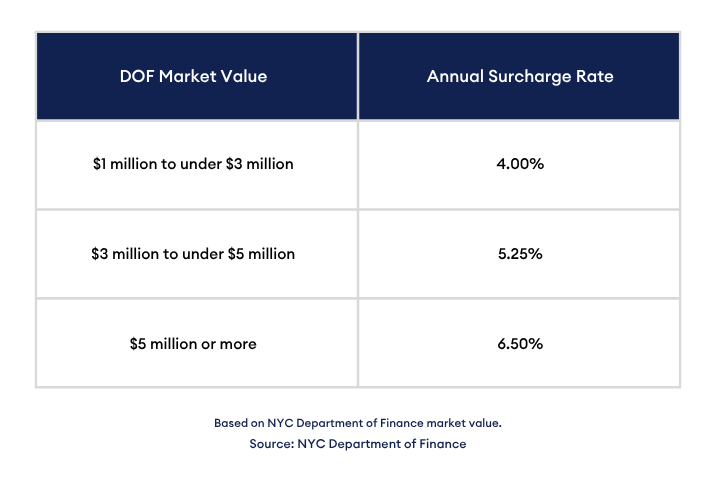
For condos and co-ops during the 2026-27 and 2027-28 property tax years, DOF currently lists three brackets: properties with a DOF market value of $1 million to under $3 million pay a 4.00% annual surcharge; $3 million to under $5 million pays 5.25%; and $5 million or more pays 6.50%.
The surcharge is annual and comes in addition to existing New York City property taxes.
What Does the Tax Cost on a $2M, $5M or $10M DOF Valuation?
Assuming a condo or co-op with no exemption, a $2 million DOF market value produces an estimated $80,000 annual surcharge, a $5 million DOF value produces $325,000, and a $10 million DOF value produces $650,000.
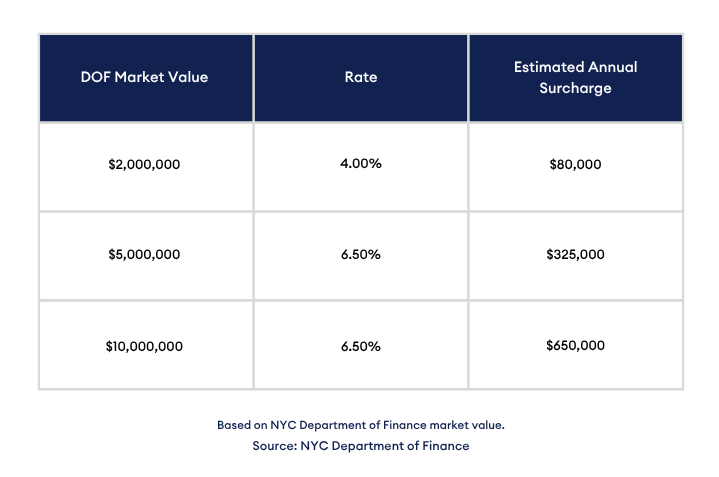
Keep the Griffin math in mind as you read that table. A $10 million DOF valuation implies an apartment whose true market value is likely a multiple of that figure. Conversely, an apartment you could sell for $10 million today may well sit in a lower bracket than you fear, or below the $1 million DOF threshold entirely. Real numbers, worth taking seriously, but a serious number deserves a serious analysis rather than a reflex.
Our Advice: Three Moves Before You Change Anything
At the Steven Cohen Team, we’re telling owners to do three things before making any decision about a New York property they love.
First, confirm your actual DOF market value. Many owners are reacting to their apartment’s market price, which is the wrong number, and as the examples above show, the two can differ by an order of magnitude. The surcharge brackets are keyed to the lower one.
Second, confirm whether an exemption already applies. If the apartment is the primary residence of the owner, a part-owner, or a tenant, it generally should not be subject to the surcharge. The City’s records have to reflect that, which is exactly why roughly 17,000 owners received notices this summer.
Third, respond to any DOF notice by September 18, 2026. Receiving a letter does not mean you owe the tax. It means the City could not confirm your exemption from its records, and you have until the deadline to document it.
With those done, the hold-rent-sell question becomes much clearer, and for most of our clients it resolves in favor of keeping the home.
Option 1: Hold, the Default for Owners Who Use New York
Nothing about the surcharge requires you to change how you own or use the apartment. For owners who value having a New York home available whenever they want it, fully theirs, never someone else’s, ready on a Thursday-night whim, holding remains the default position, now with one more line on the annual budget.
Treat the surcharge as a carrying cost alongside maintenance or common charges, existing property taxes and insurance, and size it honestly using your real DOF value rather than your apartment’s market price. For an owner who spends eight or ten weeks a year in the city, the realistic surcharge on many high-end apartments compares to a season of five-star hotel suites, in exchange for an asset you own, in a building you chose, that has historically been one of the more resilient stores of value in American real estate.
Two refinements are worth discussing with counsel. DOF valuations are not untouchable; assessments can be challenged through the NYC Tax Commission (applications for this property class are generally due March 1), and whether a successful challenge would reduce surcharge exposure is a question worth asking. And because the tax is under active litigation (more below), owners who hold may yet see the rules evolve.
Option 2: Rent, the Exemption Play for Long-Term Holders
A qualifying rental can remove the surcharge entirely: DOF states that a property will generally not be subject to it when used as the primary residence of a tenant or subtenant.
This is not the same as occasionally renting the apartment. DOF requires documentation supporting the tenant’s primary-residence status, such as a current lease plus proof like rent payments, a utility bill or renter’s insurance.
There is also a timing issue to respect. For the first year, current legal guidance states that planning after July 1, 2026 generally cannot be used to avoid the 2026-27 charge. Looking ahead, owners considering a qualifying rental for the second year should evaluate acting before July 1, 2027. Signing a lease today does not eliminate this year’s surcharge, but done properly it can eliminate next year’s, while the asset keeps appreciating and producing income.
For owners who want to retain a significant property long-term but use it only a few weeks a year, this is often the most elegant answer on the board.
Option 3: Sell? We’d Counsel Patience
Selling is the option that sounds decisive and is usually the least efficient response to this tax. Three reasons.
Selling does not escape the first-year charge. Current August guidance says planning actions taken after the July 1, 2026 start of the surcharge generally cannot avoid its application for the first year. Anyone selling a potentially affected apartment should have their attorney address the surcharge, and responsibility for it, in the transaction documents.
The litigation is live. The rules being challenged in court today may not be the rules in eighteen months. Selling a generational asset in response to a surcharge that is still being tested, potentially alongside other surcharge-motivated sellers listing at the same time, risks accepting a negotiated discount precisely when patience costs the least.
Selling still makes sense for some owners: those who visit rarely, have no appetite for a tenant, and would rather redeploy the capital. For everyone else, the sell decision deserves to be made on your timeline, not the tax calendar’s.
Hold, Rent or Sell: How the Options Compare
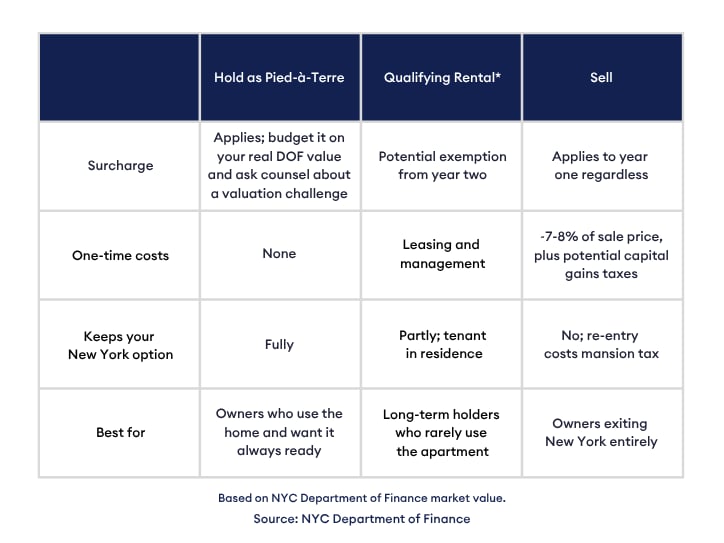
*Subject to primary-residence requirements, documentation and applicable timing rules.
The tax does not make the decision for you. It changes the math, and for most owners of significant Manhattan homes the math still favors owning.
Where Does the Court Challenge Stand?
The surcharge’s implementation is being challenged in court, but owners should continue following current DOF procedures unless the City or a court directs otherwise.
On August 10, 2026, a Richmond County Supreme Court judge issued a temporary restraining order affecting implementation. The City appealed on August 11, and under current guidance that appeal automatically stayed the restraining order pending appellate review. As of August 13, appellate proceedings have allowed the City to continue the rollout while the appeal is heard. The underlying lawsuit challenges the City’s implementation process rather than the validity of the surcharge itself.
Because the litigation is ongoing, this is the one variable every affected owner should watch closely, and a reason in itself not to make irreversible decisions quickly.
Don’t Miss the September 18 Exemption Deadline
If you received a letter from the saying your property may be subject to the surcharge and you believe you qualify for an exemption, the current deadline to respond is September 18, 2026.
Receiving a letter does not automatically mean you owe the tax. DOF says roughly 17,000 property owners received notices because the City’s records did not establish a primary-residence exemption. Owners who believe they are exempt can submit documentation for DOF review.
For properties ultimately determined to be subject to the surcharge, the charge is expected on the property tax bill issued in November 2026 and due January 1, 2027.
The Bottom Line
A qualifying condo or co-op with a $2 million DOF market value faces an estimated $80,000 annual surcharge; at $5 million, $325,000; at $10 million, $650,000. But those brackets are keyed to DOF valuations that, as the 220 Central Park South example shows, can sit at a small fraction of what an apartment is actually worth. For most owners, the realistic surcharge is smaller than the cost of giving up a Manhattan home: the transfer taxes and commission of an exit, the capital gains bill, the mansion tax of any return, and the option value of a residence that is always yours.
Know your actual DOF value. Respond by September 18 if you were noticed. Consider a qualifying rental if the apartment sits empty. And make any decision to sell on fundamentals, not on a surcharge whose final shape is still being litigated.
Own a pied-à-terre that received a DOF notice, or considering acquiring one while other owners rethink theirs? Contact the Steven Cohen Team for a private, building-specific read on your situation.
This article is for general information only and is not legal or tax advice. Before making a tax, rental or sale decision, consult your attorney and tax adviser about your individual circumstances.
Photo courtesy of StreetEasy
Frequently Asked Questions

What is the NYC pied-à-terre tax?
It is an annual property tax surcharge, effective July 1, 2026, on high-value New York City homes that are not the primary residence of the owner or a tenant. For condos and co-ops it ranges from 4% to 6.5% of DOF market value per year, on top of regular property taxes.
Is the pied-à-terre tax based on my apartment’s sale price?
No. For condos and co-ops during the first two tax years, the surcharge uses the applicable DOF market value, which typically sits far below an apartment’s likely sale price. The most famous example: Ken Griffin’s 220 Central Park South penthouse sold for roughly $238 million but carries a DOF market value of about $15.5 million.
How far below market value is a DOF valuation?
It varies by building, but the gap is often dramatic because state law requires the City to value condos and co-ops as if they were rental buildings. Griffin’s $238 million penthouse is valued around $15.5 million; his 740 Park Avenue units, purchased for $83 million combined, are valued around $6.2 million. Check your own Notice of Property Value before assuming anything.
How do I find my DOF market value?
It appears on the annual Notice of Property Value that DOF mails each January, and in your property’s records on the website. Check this number before making any decision. It is usually lower than owners expect.
Does a $5 million apartment automatically owe $325,000?
No. The $325,000 example assumes $5 million of DOF market value, which falls in the 6.5% bracket ($5 million and above; $3 million to under $5 million pays 5.25%). An apartment with a $5 million sale or asking price will usually have a substantially lower DOF valuation and a substantially lower surcharge.
Can renting out my pied-à-terre make it exempt?
Potentially. A tenant or subtenant using the property as a qualifying primary residence generally supports an exemption, subject to DOF’s documentation rules. For the first year, however, current legal guidance says planning after July 1, 2026 cannot be relied upon to avoid the 2026-27 charge. The rental path is a year-two strategy, best evaluated before July 1, 2027.
If I sell now, do I avoid the 2026-27 surcharge?
Do not assume so. Current guidance says planning actions taken after July 1, 2026 generally cannot eliminate first-year exposure, and selling also triggers transfer taxes, commission and potentially capital gains. Have counsel review how the surcharge affects your specific transaction.
Can I challenge the DOF valuation my surcharge is based on?
DOF assessments can be challenged through the NYC Tax Commission, with applications for this property class generally due March 1. Whether a successful valuation challenge reduces surcharge exposure is a question for your attorney, but for owners planning to hold, it is worth asking.
What is the pied-à-terre tax exemption deadline?
September 18, 2026 is the current DOF deadline for owners who received a surcharge notice and believe they qualify for an exemption.
Sources
Sheppard Mullin (August 11, 2026): NYC’s New Pied-à-Terre Tax: What Property Owners Need to Know
CNBC (August 13, 2026): Mamdani’s NYC pied-à-terre tax can continue rollout during court appeal
The Real Deal (February 2019): The city values Ken Griffin’s record-setting $238M penthouse at $9M
Yahoo Finance (May 30, 2026): We did the math on Ken Griffin’s pied-à-terre tax bill